Just around Christmas time, I got an invite to the closed alpha testing for Thymer, a new note-taking editor that I’d been keeping my eye on for a while. Having heard about it in early 2024, I had been slowly following the developers’ updates and the subreddit with eager anticipation.
Thymer had a lot of the things I was looking for in an editor, promising to combine both long-form writing and outliner functionality. There’s hardly any app out there that can do both equally well. The developers also made multiple references in their showcases to the flexibility of Thymer’s data structure, and to the fact that you could build custom plugins and custom collections.
While it’s still very early days for Thymer, having released the alpha version less than a month ago, many of the invited people who flocked to it have already formed a fantastic community that is building things at breakneck speed. Spending years custom-building your own data structures and app from the ground up lets you expose so many powerful ideas, allowing people to get creative and build on top of it.
Not to be outdone, I started working on things as soon as I got my hands on it. It took me a little while to wrap my head around how Thymer works, particularly its use of Collections and Records.
A record can be considered a page or a note in itself, but it also has underlying properties. Each line within it can also be its own “node” or line record, which can in turn have its own properties—although this hasn’t been exposed to users as much at this stage.
This means each line can be transcluded, and tasks can be referenced quite easily, amongst other things.
Every record belongs to a Collection. Pretty much everything in Thymer now lives inside a collection, and how you use those collections is where things get really interesting. You can have collection-specific plugins that apply only to a single Collection, or global plugins that work across all Collections.
I decided fairly early on that while I liked the idea of having a collection with multiple records, using each record solely to write about that collection was not something I wanted to keep doing long-term.
So, for example, if I wanted to write about a movie I had seen, I didn’t want to manually create a separate record for it. Instead, I wanted to use the Journal—the daily record for that day—to write about it and simply create the movie entry from there. Lo and behold, not only was it possible to create a global plugin that could do exactly that (AI-assisted coding to the rescue), but I was also able to create a collection plugin that would automatically fetch the movie’s details and fill in some predefined properties.
While the global plugin was specific to my own workflow—namely creating things by mentioning them in the Journal page—I wanted to share the collection plugin and continue improving it. This became the Media Tracker plugin, which I shared publicly with other Thymer users.

Thymer, however, turned out to be far more powerful than that. As the developers shared more information and other creators contributed their own plugins and documentation, I increasingly realised just how extendable the system could be.
I began creating new plugins at breakneck speed, ranging from a mini-CRM system to a full-fledged activity tracker. The latter gathers all the records I create or update each day, week, and month, and serves as the foundation for a weekly review process.
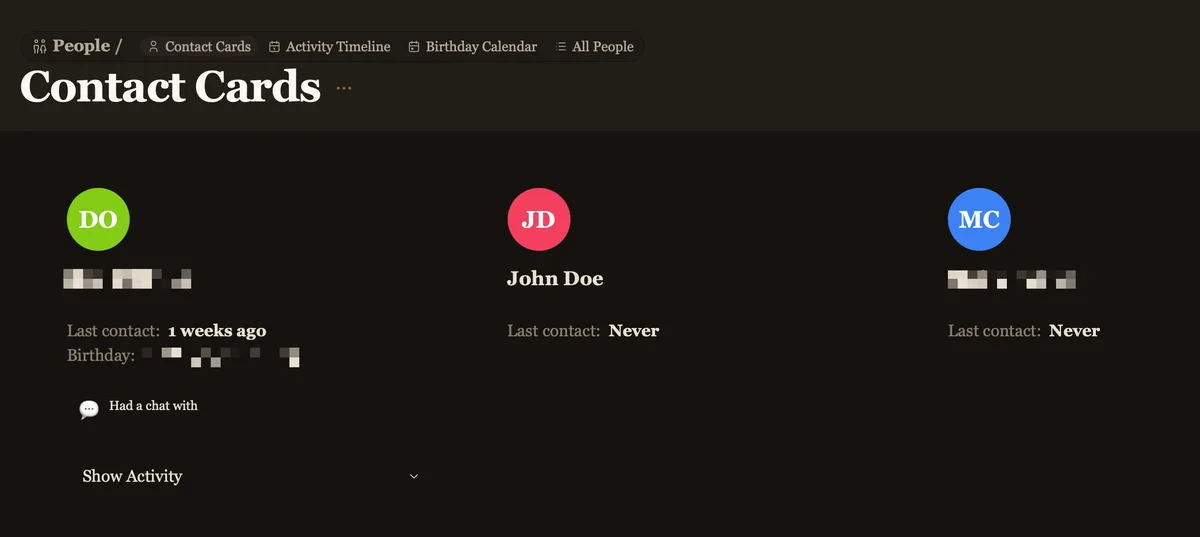
That said, my creative efforts can’t sustain themselves on building things purely for the sake of building things. I also need to use the tools I’ve built and enjoy the fruits of my endeavour, if you will. Because of that, I significantly slowed down my efforts to create new plugins and instead focused on using Thymer more deliberately day to day. While work and other commitments have prevented this from becoming a fully consistent daily habit, I intend to make it one.
As part of my resolution for this year, I’ve set out to track as many of the things I do and enjoy as I can. Having a system that I’ve built myself, tailored to my own needs and workflows through Thymer, might very well be the best way for me to do that. The year is still young, though, and things will inevitably change.
For now, I’ll continue to enjoy using Thymer while refining my existing plugins and processes, and perhaps sharing more along the way. Eventually, I do want to spend some proper time writing about just how powerful Thymer is, and how my system works in practice.